There's a moment every analyst knows and never talks about.
You've built the dashboard. The chart is clean. The line goes up and to the right, or down and to the left, and the room nods along because the story feels true. Nobody asks what's missing — because a chart never tells you what it left out. It just sits there, confident, finished-looking, daring you to trust it.
That confidence is the problem. And it's about to get a lot more interesting, because the tool we built to fix it — AI — has the exact same flaw, just wearing a nicer suit.
The Lie Every Dashboard Tells
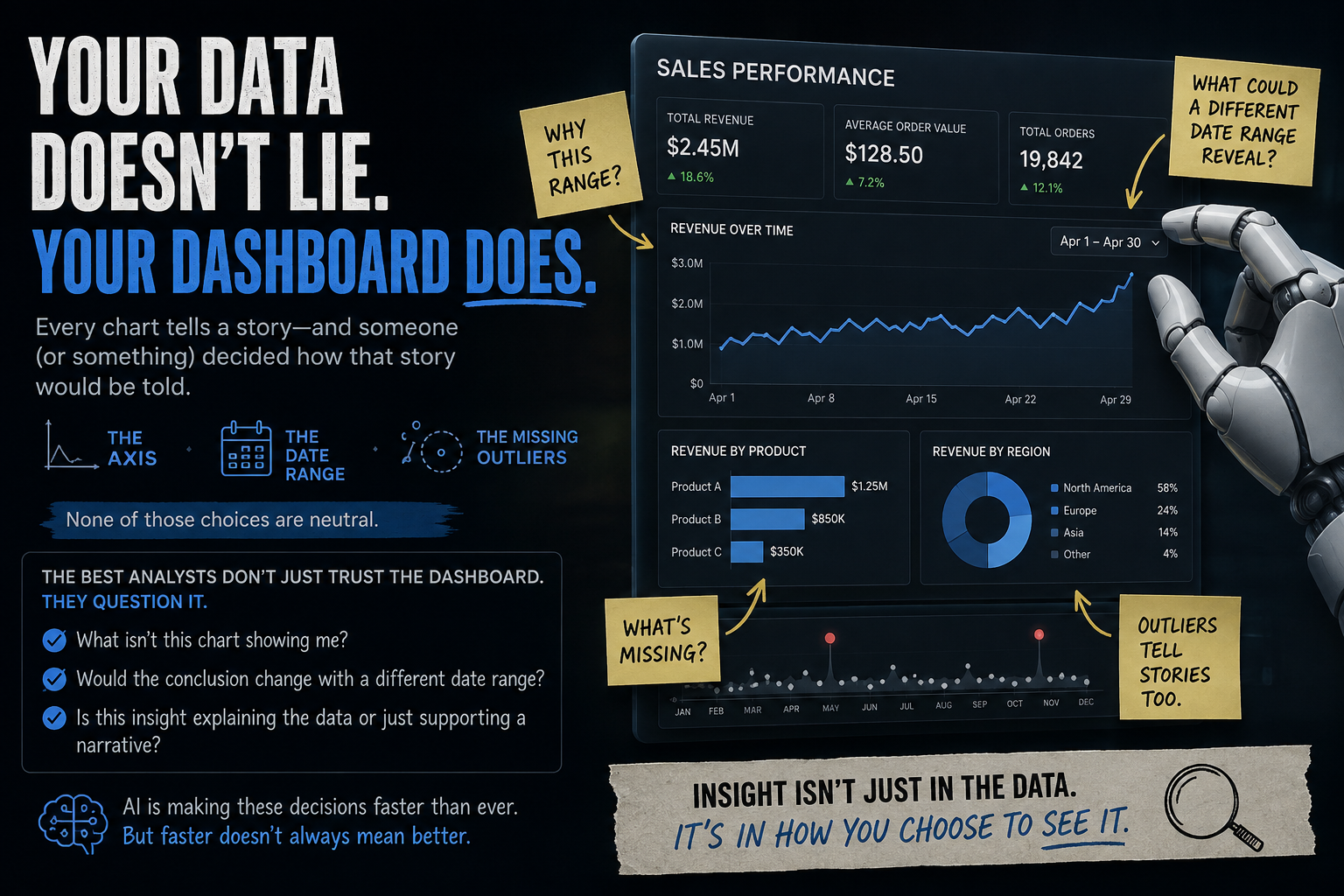
Here's the uncomfortable truth about data analysis: a chart is not a fact. It's an argument. Someone chose the axis. Someone picked the date range. Someone decided which outliers were "noise" and quietly dropped them before you ever saw the data. By the time a number reaches you, it has already survived a hundred small decisions — and every one of them shaped the conclusion, even though none of them show up on the slide.
For decades, that was a human problem. Now we've handed the axis-picking, the outlier-dropping, and the story-shaping to machines that can do it a thousand times faster than any analyst ever could. Which means the old flaw hasn't gone away — it's just gotten industrial-strength.

The Part Nobody Puts in the Pitch Deck
AI adoption in analytics has moved past the experimental phase — this is no longer a "someday" technology. Enterprise use of AI has become close to universal, and productivity gains from it are now something most companies openly report. But there's a quieter statistic sitting underneath all that momentum, and it's the one that should actually keep you up at night: more than half of businesses still say data quality is the single biggest barrier stopping AI from delivering real value — and a majority of CEOs admit they've seen no measurable return from their AI investment in the past year.
Read that twice. We're pouring trillions into infrastructure and models, and the bottleneck isn't the AI. It's the data we're feeding it — the same messy, biased, incomplete data that was quietly lying to us in spreadsheets long before any of this started.
AI didn't fix the lying. It just learned to lie faster, more fluently, and with far more conviction than we ever could.
Why This Is Actually Good News
Stay with me, because this isn't a doom post. It's the opposite.
For the first time, the flaw is visible at scale. When a human analyst quietly dropped an inconvenient data point, it disappeared into a footnote nobody read. When an AI model does it, it does it consistently, repeatably, and — if you know where to look — traceably. The very speed that makes AI dangerous also makes its blind spots easier to catch, if you build the habit of looking.
The analysts who are going to matter over the next five years aren't the ones who can build the fastest model. They're the ones who've kept the oldest skill in the profession alive: the reflex to ask, what isn't on this chart?
The Humans Who Are Winning Right Now
Something unexpected is happening in the field. The teams pulling ahead aren't the ones with the biggest AI budget. They're the ones treating AI like a brilliant, overconfident intern — someone worth listening to, never worth blindly trusting.
Picture the analyst who used to spend six hours cleaning a dataset by hand. That grind is basically gone; a model does the first pass in minutes. But that saved time hasn't made the analyst less important — it's made the judgment part of their job the whole job. The cleaning was never the valuable part. Knowing which anomaly is a fraud signal and which one is just a Tuesday was always the valuable part. AI just stripped away the busywork that used to hide that skill.
This is the quiet, human center of the AI-in-analytics story: the technology isn't replacing the person who asks good questions. It's making that person impossible to hide from — and impossible to replace.
Three Questions to Ask Before You Trust a Single Chart Again
- What did the model decide not to show me? Every summary is a compression. Ask what got compressed away.
- Would this conclusion survive a different date range? If the story only works with this exact window, it's not a trend. It's a coincidence wearing a trend's clothes.
- Who benefits if I believe this at face value? Not maliciously — just structurally. Dashboards are built by people with goals, and AI models are trained on data shaped by people with goals. Somebody's incentive is baked into every axis.

The Future Isn't AI vs. Humans. It's Curiosity vs. Convenience.
The real fight in data analysis was never machine versus person. It's the same fight it's always been: the comfortable, finished-looking answer versus the harder, better question underneath it. AI just raised the stakes, because now the comfortable answer arrives instantly, beautifully formatted, and sounding completely sure of itself.
The professionals who thrive won't be the ones who trust the machine least or most. They'll be the ones who stayed curious enough to keep poking at a number even after it looked done. That instinct — the refusal to let a clean chart be the end of the conversation — was never really a technical skill.
It was always just good, stubborn human thinking. AI didn't make that obsolete.
It made it the whole job.